June 2, 2011-Orientation Day One
Read: Joshua 1:1-9
• God knew Joshua was nobody and did not have the strength.
o It was an encouraging command that it comes from God!
• God fulfills His promises
• He is always faithful (v. 4-6), even as He was with Moses
First Day!
Long four hour bus ride! Met team leader Nathan along with other team members Amar, Leah and Jared. We bonded really quickly. There were about twenty-six other teams at orientation. These teams will be all over the world serving! The majority of the other students will be in the Philippines. We are the only ones headed to India!
Today was security training. I was scared stiff! There were five men who came in shooting AK47 blanks during a video clip of the hostage. They wanted us to learn not to fear guns or those with them. It was very good preparation because we all could potentially be put in that kind of hostage situation.
Later that day, we learned the meaning of Nehemiah Teams, the International Mission board group we were going with. Basically, Nehemiah rebuilt the wall of Jerusalem in 52 days. We can rebuild or build the spiritual wall for Christ in other countries. For this reason also we will be memorizing verses. Twenty-six. These will represent the ten different walls that Nehemiah built for the city.
Thursday, October 20, 2011

Gone to INDIA! .............Kolkata that is (Note: I am posting this post facto)
 |
| Beautiful Victorian Memorial |
Background
Kolkata, capitol of the West Bengal state of India, is renowned for its rich heritage and vibrant cultural history. Known as the City of Joy and the City of Palaces, the beauty of Kolkata is easily noticeable by its many nicknames. The World FactBook administered by the Central Intelligence Agency reports that Kolkata is religiously named for the Hindu goddess Khali of chaos and destruction.
Symbols
One of the most recognizable symbols of Kolkata is its beautiful Howrah Bridge which connects Kolkata to its sister city Howrah. Officially completed by the British in 1943, the bridge is technically a cantilever truss bridge and spans 1500 feet suspended over the Hooghly River on 270 foot high pillars. The bridge represents the great architectural influence of the British on the city.
Language
India has twenty-two different languages and while Hindi is the national language, Bengali is the primary tongue in Kolkata with 55% regularly speaking it. Other languages spoken in Kolkata include Hindi 20%, English 10% and others representing 15% of the total population
History
Historically, Kolkata has a pretty oppressive background. Christopher Anzalone an esteemed writer for the Encyclopedia of World History reports, “From its appointment as the former capitol of India to its struggle for democratic independence, the shaping of its culture was largely due to its political history” He continues to state that prior to the seventeenth century, this region of India was little more than a widespread community of small rural villages and much less the cultural capitol of India, as it is known today (Anzalone). It was competitively ruled by various emperors from the Pala, Sena and Deva dynasties from the eighth century until the twelfth century.
In 1192, the Mamluk or Slave dynasty overtook the imperial dynastic lines. Mamluk, a Muslim soldier, travelled throughout the vast northern region of India throughout his reign and is greatly responsible for the Islamic influence in Kolkata (Anzalone). His rule was shortly undermined by the Balbans; and the cycle of continual dynastic rule continued through the seventeenth century with the Shahs after the Balbans, then the Abyssinians and finally the Mughals.
The true potential of Kolkata was recognized by Job Charnock who, wishing to increase international trade opportunities in 1690, laid plans for British Calcutta. These were the early days of the East India Company; and its need of a port city made Kolkata a promising prospect, as it was conveniently located on the eastern banks of the Hugli River(Anzalone). It was an ideal location for exporting raw materials and importing finished goods. At the time, West Bengal was controlled by the Nawabs who had taken over as the Mughal power was waning. When the British opened a factory at the Cassim Bazaar, their colonial intentions became clear. Before long, the East India Company bought land revenue rights and in time instituted its own presidency.
As the British regime expanded beyond Kolkata, keeping control became difficult at times. Fort William, named for King William I, was built in Kolkata in 1706 to protect the trade routes of the Company. When it was attacked in 1756 by Siraj ud-Daulah, the last independent Nawab of Bengal, the city was captured and renamed Alinager (Anzalone). This triggered the Battle of Plassey where the British under Robert Clive defeated Siraj in 1757. Anzalone continues to say that from this point forward, the Nawabs were puppet rulers in the eyes of the Brits. When Mir Jafar replaced Siraj as Nawab, Clive personally escorted him to the throne. When he attempted to demonstrate his power through a closet alliance with the Dutch, the Battle of Chinsurah ensued and resulted in the establishment of a Governor General of Bengal in 1771. This new position deprived the Nawabs of executing any real power. The British, then, named Calcutta the capitol of British India; and so it remained until 1912, when it was moved to Delhi.
According to the Encyclopedia Britannica, the British made great advancements in Kolkata. By the dawning of the twentieth century, the port at Calcutta was the primary supplier for all of Bengal, Bihar, Assam and a number of the Northwestern provinces. At the onset of the industrial age and the birth of heavy machinery, trade items from Calcutta reached the far ends of northern India with opium and indigo making up more than half of all exports. The dynamic growth of the industry attracted many of the rural poor seeking jobs (Britannica). When employment was available, the commute to and from the city became too difficult and most relocated to the filthy living conditions of the city, creating the slums. The British preferred to separate themselves from the Indian people and eventually a dual society existed. The gap became narrowed by the constant close trading interactions. When the British began to hire Indians and then educate those in their employ, an elite class of manifested.
This higher Indian class began to learn the culture of the British and the ways they were exploiting the people and their resources. With this knowledge, there was great discontent and chaos within the chaste. A great number of them split and sided against the British and created another class entirely. When the common people backed this new class, the British were constantly bombarded with revolts. However, they were suppressed until the British were forced to relinquish all rule of India in 1947, but the clashes of the classes remain to this day (Anzalone).
Kolkata’s history explains the rapid rise of population, creation of the slums, tension between classes and the drastic variety between neighborhoods.

Geography
Kolkata is located in the eastern part India and is centered at 22.3 degrees north latitude, 88.2 degrees east longitude (NASA).The city proceeds in a north to south direction expanding linearly along the banks of the Hoogly River. The Telegraph, a newspaper in Kolkata, recently released an article explaining how majority of the city was a marshy wetland, becoming industrialized over years to support its quickly multiplying population. The remaining wetlands have been marked areas of reserve by the state of West Bengal (The Telegraph).
Common to most of the Indo-Gangetic plains, the primary type of soil and water in Kolkata is alluvial (The Telegraph). The city’s underlay consists of sediments made up of clay, silt, various deposits of sand and gravel. These sediments are tightly enclosed between two thick clay levels. The Bureau of Indian Standards reports, Kolkata is classified in seismic zone-III, on a scale of one to five where five is the most likely to experience earthquake activity.
Politics
Currently, Kolkata is under several overlapping civic administrations. The KMC or the Kolkata Municipal Corporation officiates and has jurisdiction over the local city itself. The KMC has a locally elected council of 141 ward members and these members choose a council chairman and executive mayor (The Official Website of the Kolkata Municipal Corporation). The elected mayor then selects a deputy mayor and ten members forming the Mayor-in-Council which operates similarly to a cabinet. The current mayor is Sovan Chatterjee. Kolkata is unique because no other state has implemented a system of political executive in its local government.
Natural Resources
The most famed natural resource of Kolkata is its Hooghly River which is the city’s only tributary to the infamous Ganges River of India. The Hooghly River is an important source of water as it is used for the many hydraulic plants of the city (Hazard Profiles). It is also used for drinking.
The World FactBook also lists coal as an important resource of India in general. India has the fourth largest reserve in the world. India as a whole also capitalizes on iron ore, manganese, mica, bauxite, rare earth elements, titanium ore, chromite, natural gas, diamonds, petroleum, limestone, and arable land (World FactBook). Additionally, India is the world's largest producer of licit opium for the pharmaceutical trade, but an undetermined quantity of opium is diverted to illicit international drug market (World FactBook).
Social Structure and Issues
Family is another key aspect to Bengali culture. Families assign each members role down to education, employment and marriage. Women are considered inferior to their male counterparts but are encouraged to work equally as hard.
As mentioned earlier, there was a complex caste system that existed in all of India. When it was abolished in 1947, the prejudices continued and the tension is still very real to this day. Crime occurring due to interclass friction accounts for over twenty-five percent of all reported crimes in Kolkata (World FactBook). Usually these struggles occur between those in poverty and in the slums. The slums has its own mini-chaste system as well. The following are average family incomes for various slum classes as reported from Dr. Kitai Kundu in his article, The Case of Kolkata, India, “Income categories identified by studies made during a wellbeing exercise include high (Rs 1500-5000 per month - ca. US$ 33- 110), medium (Rs 800-2300 per month - ca. US$ 17-50), and low (Rs 500-1500 per month - ca. US$ 11-33).”
He continues to provide evidence where eighty percent of all households were found earning Rs 500 and Rs 1700 (ca. US$ 11-37) per month. All of the information demonstrates that with an average family size of five or six, more than seventy percent of those living in the slums live below poverty line. Poverty characterizes the majority of the population and beggars are more than common.
Religion
Hinduism is by far the major religion of Kolkata. Records from a recent census of the city reported by the World FactBook claims 73% of the population in Kolkata is Hindu, 23% Muslim, 2% Christian and 1% Jains. Other minorities exist such as Sikhs, Buddhist, Jews and Zoroastrian constitute the rest of the city's population.
Educational Models
The overall literacy rate in the slums is 28.5 per cent, the same for women is 25.2 per cent (World FactBook). While 14.5 per cent of males have attained secondary level and 3.9 per cent of males have attained graduation or above level, corresponding levels for women are 7.3 and 1.3 per cent respectively. Any purposeful literacy program in slum areas in Kolkata should consider completely illiterate people and people with below primary level of education as its target group(World FactBook) . This group includes 37.7 per cent of males, 51.9 per cent of females and 44.2 per cent of the total population.
Sports and Games
Soccer, called football, with cricket in second place, is by far the most popular sport in India (Britannica). Fields for soccer can be found in every park and schoolyard. Though girls do not usually play, boys begin at very young ages and continue to play until they are very old .
 |
| Tradish Bengali Food |
National Foods
The foods of Kolkata are popular throughout all of West Bengal, however the Hilsa fish is used in many traditional dishes of this city (Britannica). Although there are many ways to prepare and serve the fish, the most popular way is to boil it whole and then season it with various spices. The egg of the fish is given to guests to designate their position of honor in the home.
Demographics
According to a recent census by the CIA there are 1,189,172,906 people in the country of India as a whole making it the second highest populated country in the world. Of this number, 29.7% are under the age of 15, 64.9% are between the ages of 15 and 64 and 5.5% are 65 years and older. The average life expectancy for India in general is 66.8 years old with women more likely to live to be 68 and men 64. There are currently 2.4 million people in living with AIDS putting India in third place for the highest number of people living with the illness (World FactBook). For those over the age of fifteen, it has been recorded that 61% of the total population can read and write. Men are more likely to be literate with their average of 73.4% compared to women with an average of only 47.6% (World FactBook). There is a 10.8% unemployment rate and twenty-five percent of the total population is below the poverty line (World FactBook). Of those employed, 52% hold an agricultural occupation, 34% services and 14% are involved in industry.
Christianity
The first wave of Christianity arrived with the Portuguese. Christianity came to Bengal initially with the Portuguese in the 16th century. They were Jesuits, who were responsible for the major part of Christian activity (World Christian Encyclopedia). Not much information has been specifically documented on who was the first Portuguese to evangelize the area; however, it is clear that the strain of Christianity was Catholicism.
However, protestant Christianity in the area can be dated back to 1793 when the Englishman William Carey arrived. He went specifically for evangelism purposes and even left his wife and family in England for a period to do so (Beck 56). Carey spent three years studying the culture and learning the Bengali language. He moved to Serampore and here, four years later, he baptized his first Bengali convert on December 28, 1800.Carey was most known for his translation work and linguistic skills. He was elected Professor of Sanskrit and Bengali languages at Fort Williams College, and he translated the New Testament in the Bengali less than a year later, one of his biggest accomplishments (Walker 87). In 1808, he published the New Testament in Sanskrit and on June 24, 1809 the complete Bengali Bible was finished. Carey was very dedicated in his work and sought for everyone around him to come to the saving knowledge of Jesus Christ. Shortly after he began a Marthi and Punjabi New Testament translation (Walker 128). These were finished in 1811 and 1815 just before his completion of the Old Testament in Sanskrit in 1818. He also opened two evangelical schools where locals and foreigners can learn the truth of God’s word. He died at Serampore on June 9, 1834 (Walker 176).
Since its tough beginnings, the present state of Christianity in Kolkata has not drastically improved. There are churches. Some more modern contemporary churches but most are house churches. Missions still has a live role in the city however. Mandryk, in his most recent copy of Operation World, reports that here are currently, 150,000 Christians in the city today; but only a small portion of these are Bengali speakers. There are about 200 denominations and agencies at work in this area and they focus on unreached groups
 |
| William Carey! |
William Cary and those who followed after him did much in Biblical translation and there is evidence of the work they accomplished. However, West Bengal is currently the most unreached place despite their fervent efforts. Christians are still less than one percent of the total population.
There is still great work to be done. As stated earlier, Kolkata and West Bengal have the highest percentage of unevangelized people. Operation World states that sixty-seven people groups are unreached and unengaged and twenty-seven of them have populations of over 100,000. (Mandryk, 446)
As I will be serving as a missionary in India, it is my role to proclaim the Gospel of Jesus Christ, serve the missionaries on the field and collect information and report back to the states. Sharing the Gospel is my primary objective in order to win national souls to Him; and through the English classes and the relationships formed I will do so. The national believers will be taught to reach their own people and form churches.
My responsibility also includes serving the missionaries already on the field. I will encourage their efforts and graciously appease them in any way. I will also learn from their experiences and studiously glean from their cultural knowledge. Taking the initiative to ask them questions about engaging in the culture.
I also intend to collect the information that I have gained and report it back to ministries in the States. I will strive to raise the awareness of Christians here in the US that a spiritual need for missions exists; and I will also provide avenues for them to become involved. Missions is often a sided topic for many churches. By presenting my experiences and sharing how God is presently at work in India, they will visually see the need for evangelization locally and especially abroad. This way the Gospel will be advanced in Kolkata, India.
Religious Pluralism- A classical apologetic
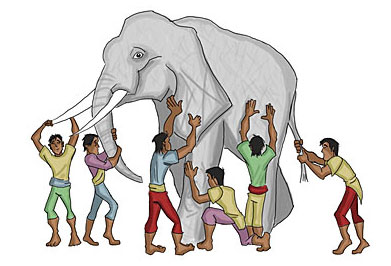
“All paths lead to God. One blind man grabs the tusk and says, ‘An elephant is like a spear!’ Another feels the trunk and concludes, ‘An elephant is like a snake!’ The blind man hugging the leg thinks, ‘An elephant is like a tree!’ The one holding the tail claims, ‘An elephant is like a rope!’ Another feeling the ear believes, ‘An elephant is like a fan!’ The last blind man leaning on the elephant's side exclaims, ‘An elephant is like a wall!’”
In India, the above parable is used to prove religious pluralism and I encountered it frequently. I disagree with the claim that all paths lead to God and this example completely and I will attempt to disprove it from a classical apologetic perspective. In this weeks reading, Boa and Bowman in chapter seven discuss briefly how a classical apologist would answer the claim of religious pluralism (B&B 209). One of the goals of a classical apologist is to prove that the opposing claim is illogical or irrational.
In the case of this example, the analogy does not prove religious pluralism as accurate, it merely paints an illustration. Secondly, religious pluralism defies the law of non-contradiction. Christianity states in John 14:6, among other passages, that there is only one path to God and that is through Jesus Christ. This philosophy claims all religions are true and therefore Christianity is true. However, if Christianity is true and states that other religions are not true this is a contradiction. Thirdly, this description proves the opposite. Ken Samples author of Without a Doubt: Answering the 20 Toughest Faith Questions explains the following:
“Ironically, while the elephant analogy attempts to validate the truth of all religions, if taken to its logical conclusion the story really shows that all religions fail to identify God adequately. So rather than affirming religious truth, the analogy implies that all religions, at least in large measure, are based on false or misleading claims”
According to Classical apologetics, these proofs show the illegitimacy of the claim that all roads lead to God.
If all paths do not lead to God then there are two options: either God does not exist or that there are limited
ways to. I would not need to prove the existence of God to a pluralist, so my next step would be to prove
that the God of the Bible is the True God.
Friday, July 1, 2011
It's week number two in India and everything is going well! My team has begun our coffee shop EV interactions and have met quite a few nationals! We have set up appointments to meet with them again this week and are so excited to know them better! One girl has been very enthusiastic and cannot wait to share more and more of her culture with us. English classes have been going well also! We have had eight students and they are as eager to learn from us as we are to teach!
Also, the team visited the historic William Carey's church last week! The current pastor there told us the story of William Carey's life and some of his personal struggles. It was truly a tremendous encouragement. We also learned that J. Adoniram Judson was baptized there!
Also, the team visited the historic William Carey's church last week! The current pastor there told us the story of William Carey's life and some of his personal struggles. It was truly a tremendous encouragement. We also learned that J. Adoniram Judson was baptized there!
This week the girls on the team earned to do Mahendi or henna. This is an ancient Indian decorative body art for the hands or feet It will be used to tell stories to nationals! This week we taught them to tell the story of Creation and the fall of man through henna!
We also were able to work at a couple of pilot schools here in Kolkata. We were picked up by bus at around 8 am. We entered the bus welcomed with screams of "Auntie!" and "Uncle!" from almost every child on there! They were so excited to see us! On the way to the schools, we learned that there were actually two schools we would be working in. One was for older children and the other for babies and toddlers. The older children were taught elementary English and some basic math before ending the day. They were ecstatic to see foreigners and loved playing with us.At the babycare center, we helped bathe, clothe and feed them before showering them with love as we played with them. I can't wait to go back!!
Nomoskar!
Greetings from Kolkata! My team has successfully landed in India and we are off to a glorious start! We visited the local marketplace where we learned a great deal about the vibrant and diverse culture of the people here. It is amazing how wide of a spectrum exists between the extremely wealthy and the desperately poor. Despite all of the differences between these groups they share the common thread of unbelief. Already we have visited two Hindu temple and Muslim mosque where we witnessed the enormous need for the saving grace of our Lord. We were so excited to pass out registration flyers for the English classes we will be teaching and finally make some connections! The classes begin this week, please pray for an abundant number of pupils and close relationships with each one!!
More to come!
Monday, March 21, 2011
Wednesday, March 2, 2011
Sufficient Grace
 Wow, how quickly has 2011 crept up on us!! Can you believe this year marks the tenth year anniversary of those horrifying plane crashes that claimed the lives of so many Americans on September 11? CRAZY! No doubt many of us distinctively remember the exact activity we busily involved ourselves in when the devastating event transpired. I was sitting in my sixth grade homeroom, awestruck at how the harbored hatred of one people group could cause the voluntarily oppression another. I also remember thinking how quickly all the Christian organizations rushed to aid in the recovery of New York and also the many prayers for the families suffering the loss of loved ones. America prayed to Jesus, the only Lord and Savior that day! Time flies by………
I am currently a senior in the Intercultural Ministries B.A program at Moody Bible Institute in Spokane, Washington and I am learning more and more of the detriment and destruction that comes from not having a personal relationship with Christ. Sadly, this is the reality of millions across the globe, especially India. India has more unreached individuals than any other nation.

 Part of my program requires an internship and I have recently been afforded the opportunity to serve in West Bengal. I, along with five other students, will be challenged & encouraged as we communicate the Gospel through teaching simple classes of conversational English & sports in India, specifically Kolkata. Kolkata is a mega-city of about 15 million people located in the State of West Bengal, India. The city population is made up of many people groups such as Bengali, Marwadi, Gujarati, Biharis, Bangladeshis, Sikhs, and South Indians. The largest group is the Bengali people. Globally, these are the world’s largest unreached ethnic group and Christians are less than one percent of the population. There are 67 people groups that are both unreached and unengaged, 27 of them over 100,000 in population. My team will be serving there from June 2 through August 4, 2011 in hopes of reaching out to these people groups by presenting the Gospel through English as a second language classes and community outreach.

 It is my prayer that we will be active witnesses of God’s love, joy, peace, and hope to them. Pray for me continually as I leave my family & friends, transition to Indian culture, and raise 100% funds for the trip. The total cost for the trip(including airfare) is $5,500 due by May1, 2011. I would like to invite you to partner with me financially and in prayer as my team seeks to increase the Christian presence among the people in Kolkata. Please prayerfully support this mission by giving any amount! Please make checks payable to Angela E Blocker. I also would like to encourage you to stay updated about service in India by following my blog (marksofastranger.blogspot.com) where ministry success stories and prayer requests will be posted. Thank you in advance for your gifts and your ministry of prayer!
Subscribe to:
Posts (Atom)